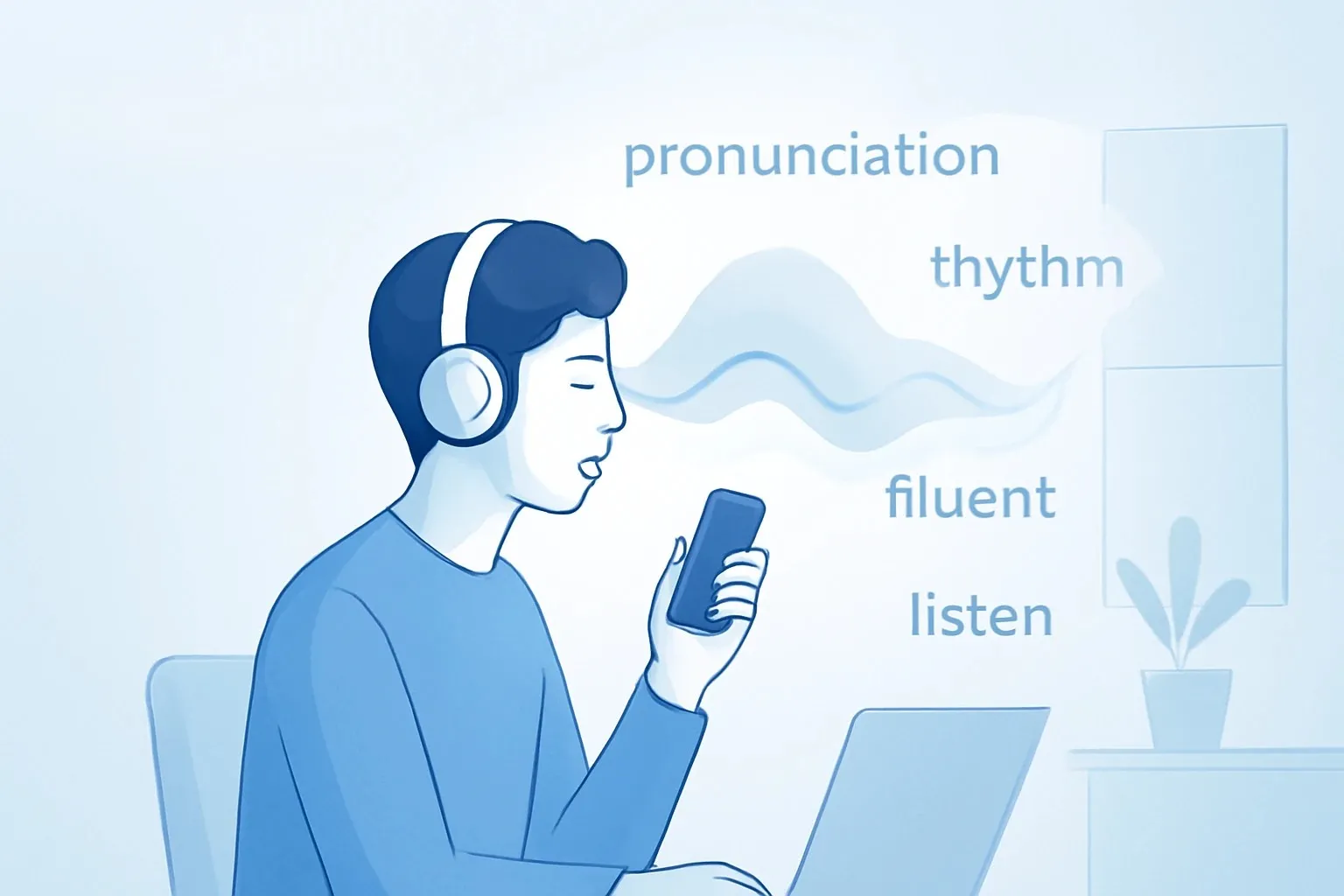
The Shadowing technique – the fastest way to simultaneously improve Speaking and Listening
Many learners think that speaking more fluently and reducing their accent requires a native teacher by their side. But a simple, science-backed technique called Shadowing can bring you the same – or even better – results at home, completely free. In this article, you’ll learn this method from A to Z with practical steps and free resources so you can transform your speaking and listening at the same time.
📑 Table of Contents
- What Is the Shadowing Technique and Why Is It So Effective?
- The Science Behind Shadowing
- Amazing Benefits for Language Learners
- Step‑by‑Step Guide (From Beginner to Advanced)
- Types of Shadowing and Choosing the Best Method
- Best Free Resources for Practice
- Common Mistakes and Solutions
- More Advanced Techniques
- How to Practise for Free at OpenEnglish
What Is the Shadowing Technique and Why Is It the Best Self‑Study Speaking Method?
Shadowing is a language learning technique in which you listen to an audio file and simultaneously repeat it out loud with as little delay as possible. This method was first systematically introduced by the renowned linguist Professor Alexander Arguelles and is now used by simultaneous interpreters, news anchors, and professional language learners worldwide.
Unlike traditional methods like memorising vocabulary lists or reading texts, shadowing forces your brain to listen, process, and produce speech simultaneously. This multi‑sensory process intensely activates neural networks related to hearing and speech, deeply embedding language patterns. Put simply, you place your brain in exactly the same path a child uses to learn their mother tongue – by listening and imitating, without grammatical analysis.
The Science Behind Shadowing – Why Does It Work?
From a neuroscience perspective, shadowing engages phonological working memory, and numerous studies show that this practice increases gray‑matter density in the auditory and motor areas of the brain. With constant repetition, your mouth and tongue muscles also adapt to the new sounds of English – exactly like training for a sport.
A 2021 UC Berkeley study found that just 20 hours of focused shadowing can improve learners’ pronunciation scores by up to 40%. That means every 15‑minute daily session yields the equivalent of several traditional classroom hours.
Amazing Benefits for Language Learners
- Simultaneous improvement of Listening and Speaking – precisely the two skills that are usually weakest.
- Accent reduction and more natural speech rhythm – noticeably softens a heavy accent.
- Increased confidence – when you hear your own voice sound more like a native speaker, you gain the courage to speak.
- Subconscious grammar learning – correct structures are etched into your mind without memorising dry rules.
- Strengthened short‑term auditory memory – helps you understand longer sentences more easily.
Step‑by‑Step Guide (From Beginner to Advanced)
🗂️ Prerequisites
All you need: an audio file with a transcript, headphones, and determination. Your language level should be at least A1 (able to recognise simple words).
Step 1: Choose the Right Audio
Pick an audio file 1 to 3 minutes long with a clear accent (American or British). Podcasts like 6 Minute English are excellent to start with. Make sure you have the transcript available.
Step 2: Active Listening (No Repetition Yet)
Listen to the file 2 to 3 times back to back. Just listen and try to grasp the overall meaning. Pay attention to the rhythm, pauses, and intonation. Then read the transcript once and look up new words (you can use an online dictionary).
Step 3: Shadowing with the Transcript (For Beginners)
Play the file and speak along with the speaker, keeping your eyes on the transcript. Try to stay exactly in step with the speaker, even if you miss a few words. Repeat this stage at least 3 times until you feel comfortable.
Step 4: Shadowing Without the Transcript (The Real Challenge)
Put the transcript aside. Now just listen and repeat with a very short delay (less than 0.5 seconds). The goal isn’t to complete the sentence, but to imitate the rhythm and intonation precisely. Don’t worry about mistakes – that’s normal. Do this stage 5‑7 times until you feel fluent.
Step 5: Record and Analyse
Record your voice with your phone and compare it to the original. Note the differences. Is your speed off? Is your intonation right? This self‑assessment feedback multiplies your progress. Choose a new audio file each day.
- Saturday to Thursday: 15 minutes daily with one 2‑minute file
- Friday: Review and free practice with the week’s files
After 4 weeks, you’ll see a noticeable change in your fluency.
Types of Shadowing and Choosing the Best Method
- Full Shadowing: You repeat simultaneously with the speaker. Suitable for beginner to intermediate.
- Delayed Shadowing: You stay 2‑3 words behind the speaker. This method strengthens working memory.
- Phrase Shadowing: You only repeat at the end of phrases. Useful for focusing on phrase pronunciation.
- Conversational Shadowing: You use dialogues from series or films. This method teaches everyday language.
To start, Full Shadowing with a transcript is the best option. Once you’re comfortable, move on to Delayed Shadowing.
Best Free Resources for Practice
- 🎙️ 6 Minute English (BBC): 6‑minute episodes at standard speed, full transcript on the BBC Learning English website. Best for A2‑B2 levels.
- 📺 TED‑Ed: Short 4‑6 minute videos with accurate subtitles and fascinating educational topics. Suitable for B1 and above.
- 📱 Speechling app: Completely free, lets you record your voice and get feedback from a human coach (not AI). Great for spotting pronunciation mistakes.
- 🎬 Short dialogues from Friends or The Office: Each scene is about 1‑2 minutes, scripts are available online, and it teaches completely colloquial language.
- 📻 NPR News Now (5 minutes): A short news podcast at a native speaker’s natural speed. Highly suitable for B2 and C1 levels.
- 🎧 ELSA Speak app: Uses AI to analyse your pronunciation at the phoneme level and gives a precise score. The free version includes targeted daily exercises.
Common Mistakes and Solutions
Many learners fall into these traps:
- Whispering: You must speak at full volume and clearly, even if you’re alone.
- Pausing to translate: The goal is to imitate sound and rhythm, not to understand every single word. Your brain will gradually absorb the meaning.
- Choosing files that are too hard: Always start with a file where you understand at least 70%.
- Lack of consistency: Even 10 minutes daily is better than one hour once a week.
More Advanced Techniques (For C1 and Above)
If you’re at an advanced level, you can try Shadowing without re‑listening: hear the file only once and immediately repeat it. This skill is vital for interpreters. Also, combining shadowing with oral summary (after the audio ends, speak about it for one minute) has a fantastic effect.
Free Speaking Practice in Our ClassesHow to Practise for Free at OpenEnglish
The Shadowing technique is fantastic, but nothing replaces real conversation with other people. In our OpenEnglish Telegram channel, we hold free discussion sessions every week on a variety of topics. You can test your pronunciation and fluency in a friendly, stress‑free environment. If you don’t know your exact level yet, use our free placement test and then join the appropriate group. For a more private programme, our private conversation classes are also an excellent option.
Click here now and join the channel. We’re waiting for you!
❓ Frequently Asked Questions about the Shadowing Technique
Research shows that 15 to 20 minutes of focused daily practice is enough. Even a single 2‑minute file repeated 7‑8 times can have a tremendous effect. The key is daily consistency, not long, scattered sessions. We recommend making Shadowing part of your morning routine before starting other tasks.
No, that’s a misconception. Shadowing can be used for all levels from A1 to C2. Beginners can start with very simple files (like “How are you?”) while looking at the transcript. As your level increases, more complex files and advanced techniques (such as Delayed Shadowing) are used.
With regular 15‑minute daily practice, a noticeable change in fluency and a reduction in hesitation is usually seen after 3 to 4 weeks. For deeper changes in accent and speech rhythm, 8 to 12 weeks of consistent practice is recommended. Recording your voice in week one and comparing it to week four will clearly show your progress.
Shadowing is an incredibly powerful supplement, but it’s not a complete replacement for real conversation. This technique dramatically improves your pronunciation, fluency, and auditory processing speed. But to learn interactive skills (like answering unexpected questions or managing a discussion), you need practice with people. That’s why we run free discussion sessions at OpenEnglish – to cover both aspects.
There are many free resources: the 6 Minute English podcast from BBC (with full transcript), TED‑Ed videos (with accurate subtitles), the Speechling app (free with human feedback), and short dialogues from series like Friends. The important thing is to choose a file where you understand at least 70% and that has a transcript available.