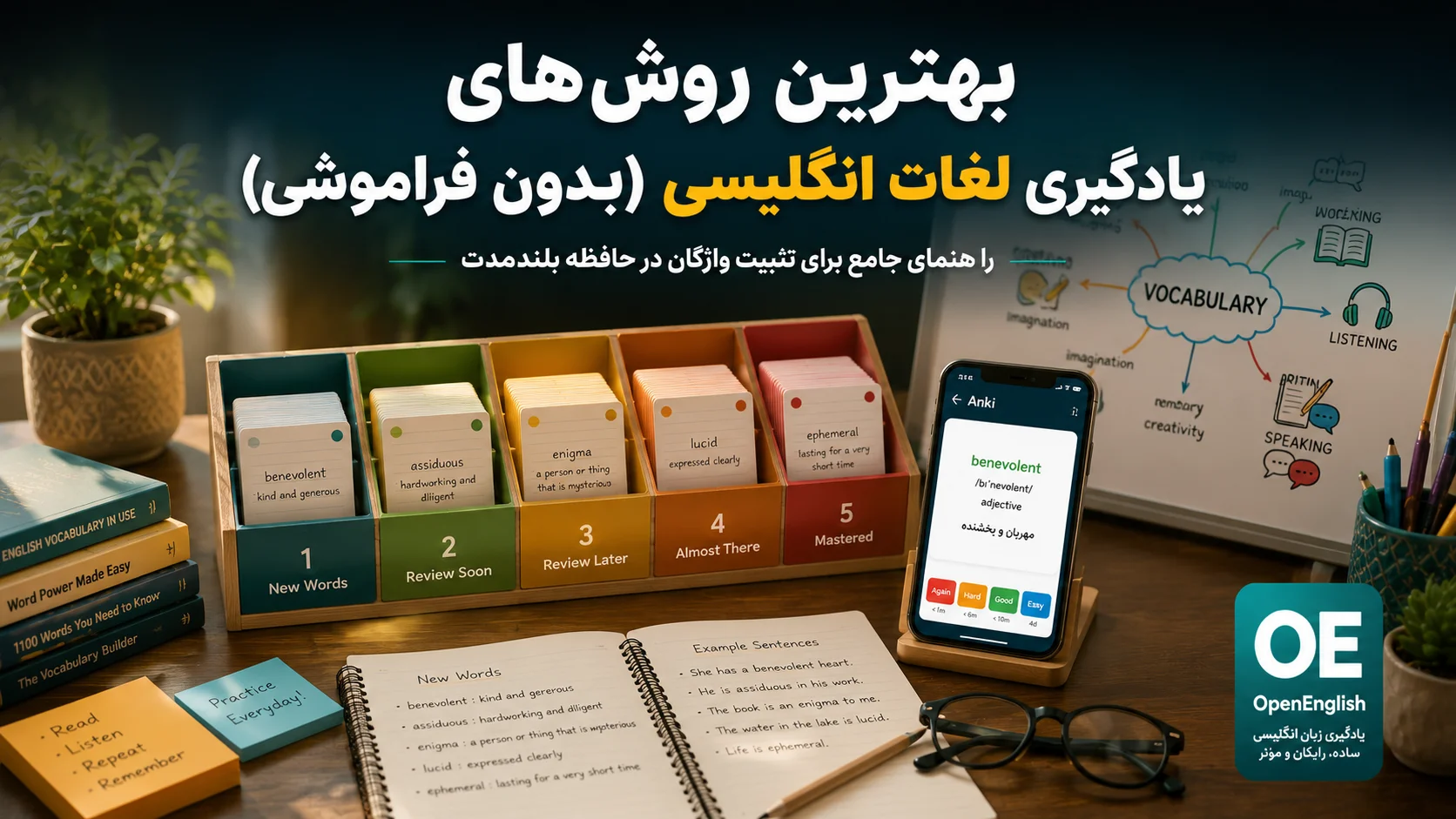
Memorising English vocabulary without forgetting – methods that actually work
You’ve probably experienced this: you memorise a word repeatedly, yet a few days later it’s completely gone. The problem isn’t your memory – it’s your method. In this article, using scientific findings and proven techniques, you’ll learn how to expand your English vocabulary and remember it for good.
📑 Table of Contents
The Science of Forgetting and How to Beat It
Hermann Ebbinghaus, a German psychologist, discovered the forgetting curve: if we don’t review new information, we forget 50% of it within an hour and 70% within 24 hours. But the solution is simple: spaced repetition. By reviewing a word at the exact moment it’s about to be forgotten, you transfer it to long‑term memory. This is the foundation of all modern vocabulary tools.
The Leitner Box – Powerful and Free
The Leitner box is a simple flashcard system you can create yourself with 5 boxes (or envelopes). New words go into Box 1. If you remember them, they move to the next box; if not, they return to Box 1. Review intervals increase: Box 1 every day, Box 2 every 2 days, Box 3 every 4 days, and so on. This manual method is still one of the most effective.
The Best Flashcard Apps
- Anki: Free (except on iOS), fully customisable, based on spaced repetition. Best for serious learning.
- Memrise: Learning with videos of native speakers, gamified environment. Suitable for beginner to intermediate.
- Quizlet: Simple flashcard creation, various games. The free version is fully functional.
Important tip: create your own flashcards – the process of making them is itself a learning step. Use personal examples.
Creative Techniques to Memorise Words
1. Mnemonics (Encoding)
Link the word to a funny mental image or a short story. For example, for the word “melancholy” (sad), imagine a crying melon.
2. Learning in Context (Sentences)
Never memorise a word in isolation. Create a full sentence that means something to you personally. The brain stores information better as stories and connections.
3. Mind Maps
Instead of a linear list, draw related words in branches. For example, write a circle labelled “Health” and branch out to “hospital”, “medicine”, “exercise”. This leads to deeper learning.
15‑Minute Daily Plan
- 5 minutes: Review today’s flashcards in Anki
- 5 minutes: Read a short paragraph and extract 2‑3 new words
- 5 minutes: Create sentences with the new words and write them in a notebook
Vocabulary Practice in the OpenEnglish Group
Nothing is better than using new words in a real conversation. In our OpenEnglish free discussion sessions, we talk about a specific topic each week, helping you keep related vocabulary alive and active. If you haven’t joined yet, follow our Telegram channel.
❓ Frequently Asked Questions
5‑10 new words a day is plenty. Quality matters more than quantity. Review the same small number using spaced repetition.
Both are good. Apps are more convenient and precise, but handwriting also has a positive effect. A combination of the two is excellent.
Write a sentence with the new word every day and try to use it in conversation that same day – even if it’s with yourself.
No, that’s the least effective method. Always learn words in sentence context and with meaningful connections.
The ones you create yourself. Using pre‑made flashcards made by others is usually less effective.